
Our Latest News & Updates
Case Study: £230k Crematorium Boiler Decarbonisation
Case Study: £230k Boiler Plant Decarbonisation at Blackley Crematorium
How do you decarbonise a crematorium? Very carefully — and with some clever engineering. Here’s how we replaced the gas-fired boiler plant at Blackley Crematorium in Manchester with a three-pump air source heat pump system, incorporating waste heat recovery from the cremator itself, all while keeping the site fully operational.
The project at a glance
| Sector | Public sector |
|---|---|
| Client site | Blackley Crematorium, Manchester |
| Role | Mechanical Contractor |
| Project type | Plant decarbonisation |
| Project value | Circa £230k |
| Outcome | Delivered & commissioned on a live operational site |
The brief
Blackley Crematorium needed to move away from its ageing gas-fired boiler plant. The brief was to fully decarbonise the site’s heating and hot water systems — cutting reliance on fossil fuels, reducing long-term running costs, and supporting the site’s sustainability targets — without interrupting the cremation service running throughout the works.
What we installed
Our scope covered the design coordination, supply, installation and commissioning of the entire new plant:
- Full strip-out of the existing gas-fired boiler plant
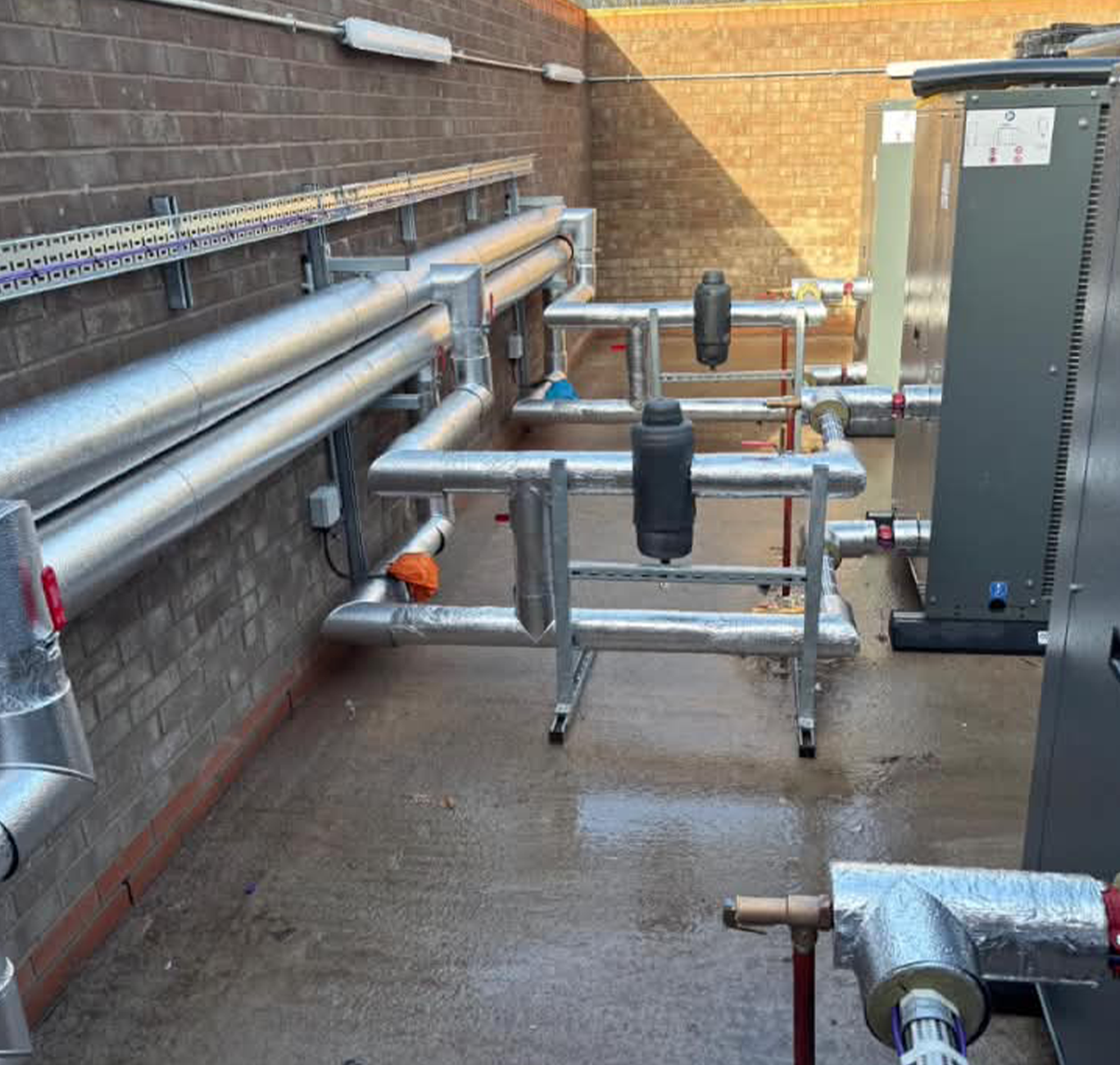
- Three Ideal 50kW air source heat pumps
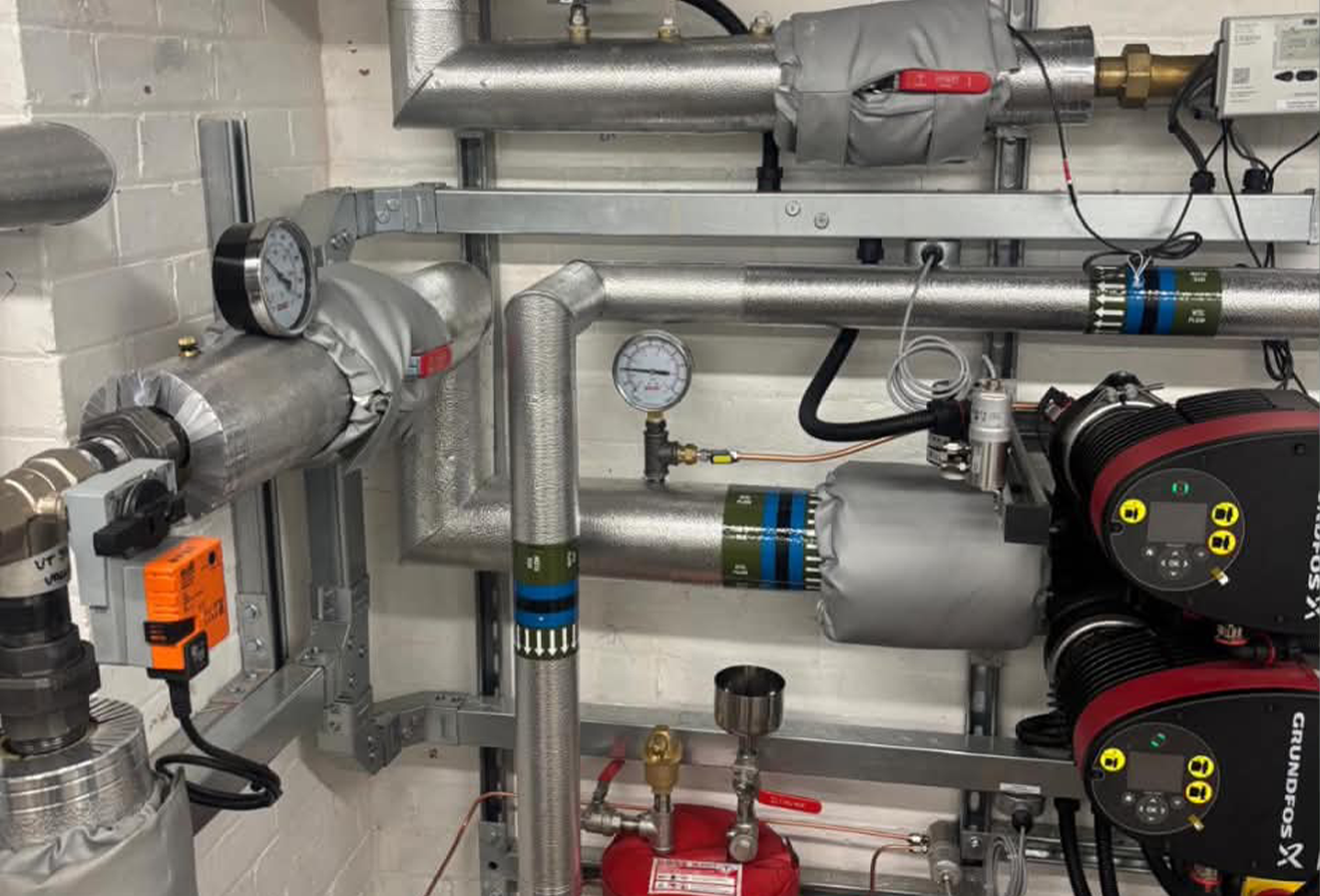
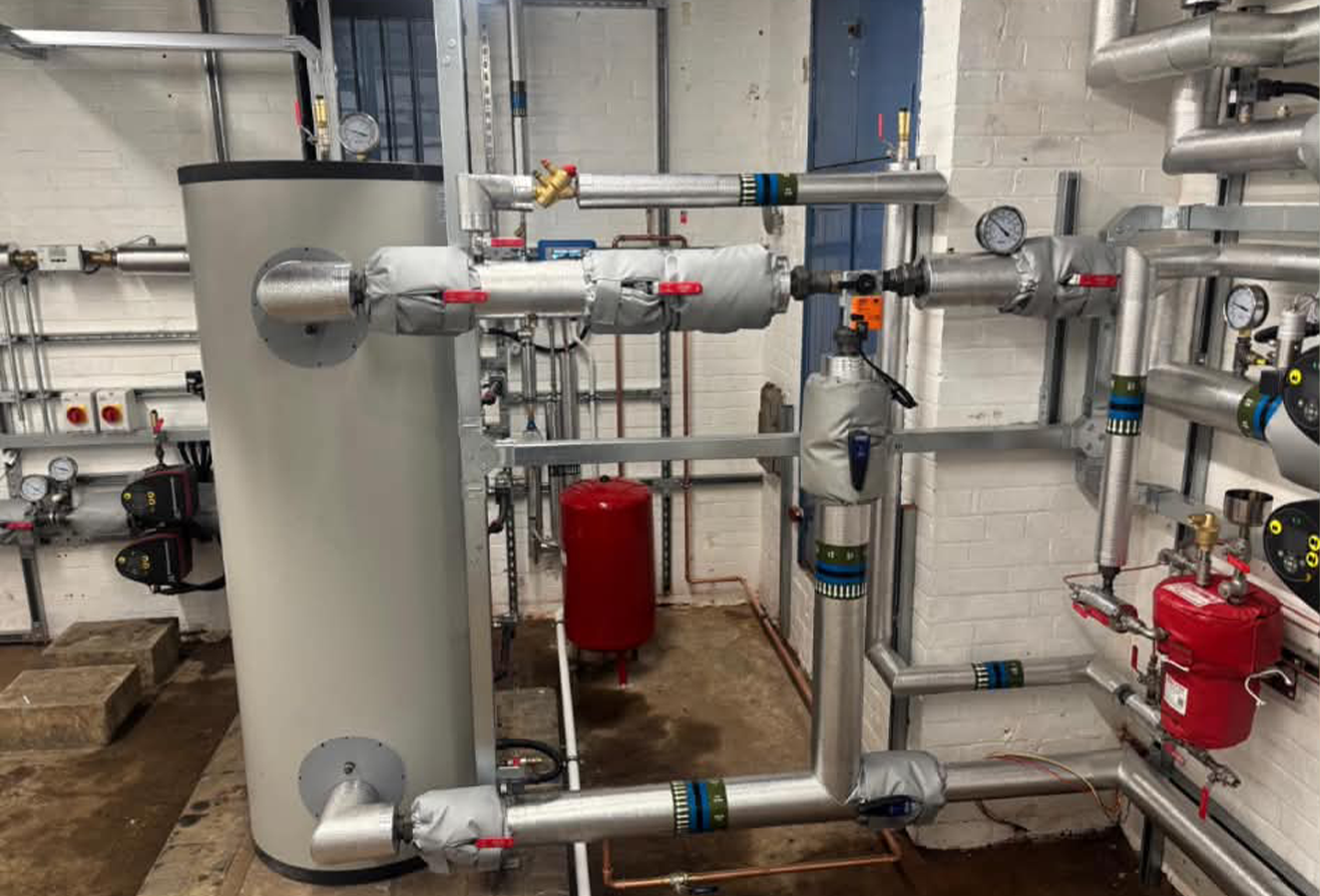
- Primary buffer tank with associated pump sets and controls
- Full pipework fabrication and installation
- Plate heat exchanger capturing waste heat from the cremator
- Additional heat recovery from ancillary plant room pumps
- New immersion-feed hot water cylinder
- Aluminium-clad thermal lagging to all internal and external pipework
- Electric trace heating protecting the external pipework
- Full test and commissioning of the completed system
The clever bit: waste heat recovery from the cremator
A crematorium is an unusual heat source. The cremation process generates significant waste heat that, on a conventional site, is simply vented to atmosphere. On this project, we specified a plate heat exchanger to capture that waste heat and feed it back into the primary system — reducing the load on the heat pumps and lifting the overall efficiency of the plant.
It’s a technique more commonly seen in industrial process recovery than in public sector heating, but it made real engineering sense here. The cremator was already producing heat. We just made sure the building got the benefit of it.
Working around a live crematorium
Unlike a school over the summer holidays or a factory on a shutdown, a crematorium can’t simply pause. Services had to continue throughout the works, which meant a carefully phased programme of strip-out, installation and commissioning — with temporary heating arrangements in place during the changeover to ensure the site never went cold.
The plant room itself was another constraint. Fitting three heat pumps, a buffer tank, pump sets, heat recovery equipment and a hot water cylinder into an existing plant space required careful routing and off-site prefabrication to keep the on-site installation clean and access maintained for future maintenance.
The results
- Fossil fuel plant removed — the site’s gas-fired boilers are out, cutting its carbon footprint and reliance on gas
- Sustainable low-carbon heat delivered — three air source heat pumps providing the primary heating and hot water
- Waste heat recovered, not wasted — cremator waste heat captured and fed back into the system, improving overall efficiency
- Modern, monitored plant — fully tested and commissioned, ready for long-term public sector service
Frequently asked questions
Can you convert a gas-fired commercial boiler system to air source heat pumps?
Yes — most commercial and public sector sites can be moved from gas boilers to air source heat pumps, though the specification depends on the site’s heat load, space available for external units, and the condition of the existing distribution pipework. A properly designed heat pump system can deliver equivalent heating and hot water performance with a fraction of the carbon footprint.
How disruptive is a full boiler plant decarbonisation?
It doesn’t have to be. On sites like Blackley Crematorium that can’t shut down, a phased programme combined with temporary heating during the changeover keeps operations running throughout. The key is planning the sequence early — the disruption comes from bad scheduling, not from the works themselves.
What is waste heat recovery, and does it apply to my site?
Waste heat recovery captures heat that would otherwise be vented to atmosphere — from cremators, industrial processes, refrigeration systems, or even the building’s own extract ventilation — and feeds it back into the heating system. It’s most cost-effective on sites with a consistent waste heat source running alongside a consistent heat demand.
Do you work across the North West?
Yes — we deliver commercial and public sector mechanical projects across Staffordshire, Cheshire, Greater Manchester and the wider Midlands and North West.
Looking to decarbonise your own boiler plant?
We deliver full mechanical decarbonisation packages for public sector, commercial and industrial clients — from initial design through to commissioning and aftercare. If you’re planning a boiler replacement, heat pump install, or a broader plant upgrade, we’d be happy to talk it through.
Get in touch to discuss your project →
|
Download the case study Blackley Crematorium — £230k Boiler DecarbonisationThe full project write-up as a 2-page A4 PDF. Scope, challenges, solutions and results — designed to share with colleagues or drop into a tender pack. |